November 26, 2025
Caroline Colino’s Fellow’s Journal Archive
This past season, Caroline Colino became our inaugural Letitia Glenn Biddle Fellow. Caroline is a horticulturist and emerging garden designer. Originally from Delaware, she has lived across the country—from North Carolina to California, Montana to Maine—learning from the landscapes, plants, and people she’s met along the way. She trained in horticulture at Longwood Gardens and went on to garden and design at Coastal Maine Botanical Gardens.
Caroline spent five months at Andalusia, working closely with the designs of Lady Arabella Lennox-Boyd and exploring the rich history and legacy of the property. She wrote insights throughout her fellowship, sharing them to the Andalusia social media accounts along with photos she took each week. Read through her journal posts below, where you’ll also find links to her original posts.
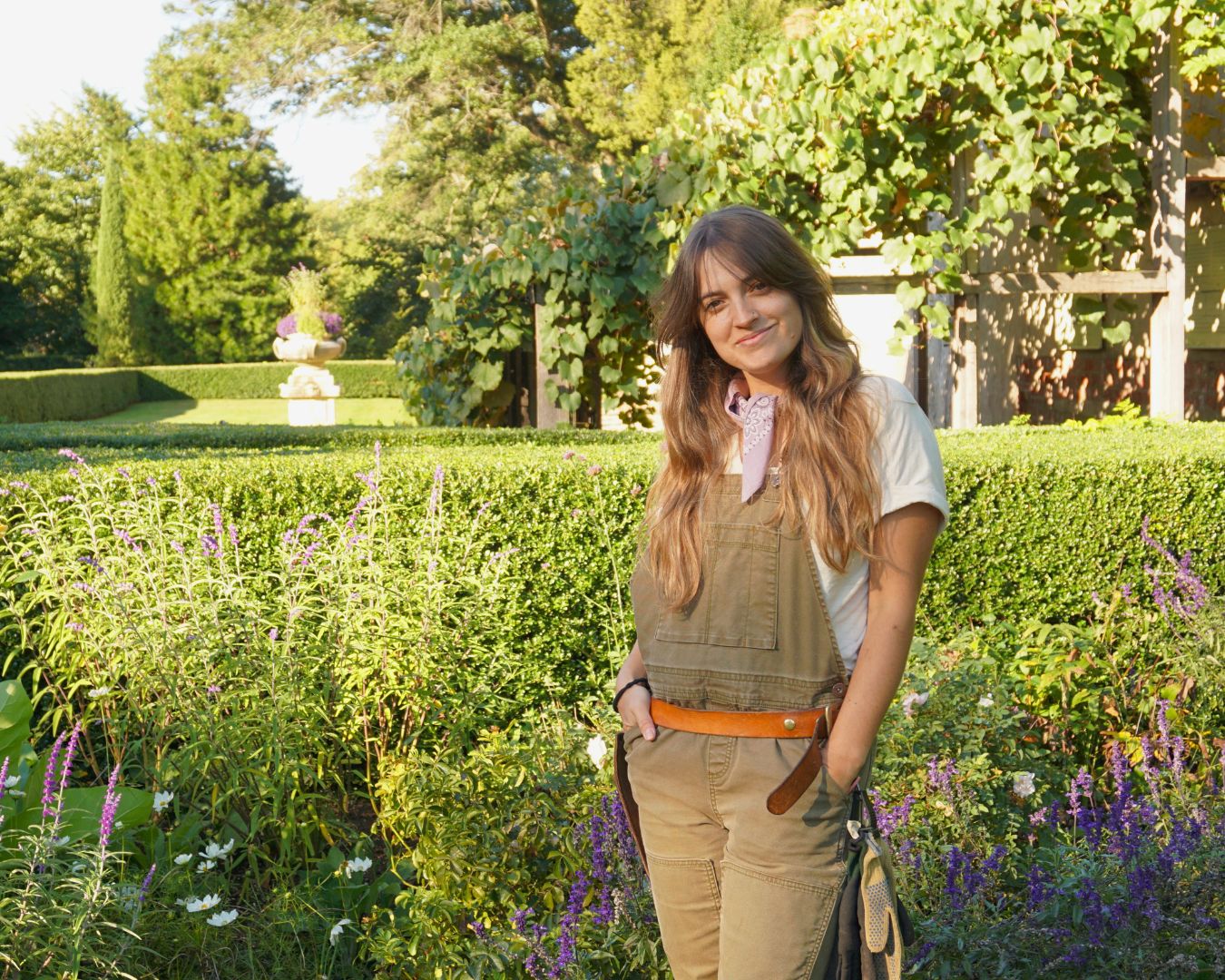
Caroline Colino in the Walled Garden.
June 20, 2025
Welcome to the #AndalusiaFellowsJournal. I’m Caroline Colino @caroline.colino and I’ll be sharing reflections from the garden throughout the season as this year’s Letitia Glenn Biddle Fellow.
I can’t believe I’ve already been here at Andalusia for a month and a half! The garden changes so quickly—flowers bloom and fade, and all we can do is breathe it in while it lasts, appreciating each flower through the stages of its life.
Speaking of breathing it in, I’ve been spending a lot of time in the Rose Garden. This space has long been home to roses, but the current collection began in the 1980s under James “Jimmy” Biddle (1929–2005), with selections from the All-America Rose Selections program. Our rosarian, Heather Schmidt, has been teaching the team and me all about these roses: their history, culture, and care.
Some of my favorites so far:
🌹 Maggie – a bourbon rose with a rich scent of sweet spice
🌹 Amaretto – an apricot-colored floribunda climber with notes of brown sugar and spring
🌹 Opening Night – a vibrant red hybrid tea that smells just like cranapple juice!
And of course, I adore the rose columns of Tess of the d’Urbervilles, which rise above the cottage garden bed like red sentinels—adding a touch of drama against the gauzy, romantic mix of nigella, delphinium, and foxgloves.
Luckily, many of these are rebloomers—so you can be sure I’ll be sniffing away all season!
June 27, 2025
For those of you outside the Mid-Atlantic, this first week of summer brought our hottest weather yet, with Tuesday reaching a scorching 100°F. I’ve been especially grateful for the trees that keep us cool while we tend the garden, and for the horticulturists who had the foresight to plant them decades ago.
One of my favorite shady spots is the Green Walk, designed by Arabella Lennox-Boyd in 2017. With dappled light, a river breeze, and a palette of soft textures and colors (inspired in concept by our native flowering dogwood, Cornus florida), it offers a kind of cool that’s both sensory and atmospheric
Right now, Hydrangea macrophylla ‘Lanarth White’ blooms in clouds of blue and white, with Astrantia major ‘Shaggy’ and Astilbe ‘Bridal Veil’ dancing down the garden path.
Meanwhile, in a sunnier spot along the walk, Yucca filamentosa is throwing its own midsummer party, sending up its tall flower spikes in full embrace of the heat!
And while it’s still blooming, I have to give a shout-out to Stewartia pseudocamellia. Its big white flowers have been absolutely buzzing with bees.
ROSE UPDATE: Since last week, I’ve had the absolute pleasure of meeting Vince Kessling, the rosarian who helped create the Rose Garden with Jimmy Biddle in 1988. With his 1987 Rose Selection Guide in hand, he walked me through each variety, recognizing them by sight and scent. It was an honor to meet someone whose deep knowledge and care have left such an impact on the garden—a humble reminder of how much of ourselves we leave behind in the work we do as gardeners.
July 3, 2025
This week has been a mix of storms, sunshine, and the subtle moments between all the motion. During a break in the rain, I spotted several hummingbird moths hovering around Scutellaria incana (downy skullcap), a soft violet-blue wildflower native to the Central and Eastern U.S. It always feels special to witness our native plants in action, quietly supporting the pollinators who keep our ecosystem alive and humming.
While planting several new and beautiful azaleas along the Azalea Walk (graciously watered in by Mother Nature), my colleague, the ever thoughtful and creative horticulturist Brendan McNabb, pointed out the delicate hop-like clusters forming on Ostrya virginiana, or the eastern hop hornbeam. This native understory tree bears papery bracts that overlap like little lanterns, each one protecting a tiny nutlet inside.
Another understated favorite this week: Hydrangea aspera. While more reserved than its showier cousins, its lacecap flowers start with muted pink buds that slowly open to periwinkle blue. They hover out over the fuzzy velvet leaves with graceful charm like cotton candy clouds.
Meanwhile in the Gold Garden, if you look high in the sky, you might catch a glimpse of Magnolia grandiflora ‘Bracken’s Brown Beauty’ still blooming overhead; look down, and the cheerful golden foliage of Tanacetum parthenium ‘Aureum’ (golden feverfew) brightens the border below.
The garden is full of small details that reward a second glance, and it’s a joy to share them here with you.
July 11, 2025
This week in the garden was all about pruning ✂️. Formal gardens like Andalusia depend on structure, and we spent time carefully shearing hedges of Ilex, Yew, and Privet into clean, crisp rows using a mix of electric, gas, and hand shears to get the job done.
Once the hedges were tidy, we moved on to one of my favorite features in the garden—and something I’d been looking forward to working on this season: the Wisteria Wall. Our fearless leader, Head Gardener Bill Fuchs, showed the horticulture team how to prune it back, cutting each long noodle of new growth down to three leaf nodes. This keeps the Wisteria neat and encourages the formation of flowering spurs on older wood. Those spurs will eventually burst open into cascades of fragrant purple racemes in the spring.
Up on a ladder 20 feet in the air, with pruners in hand, I couldn’t help but admire the view of the Tower and the tenacious little ferns growing from the cracks in the wall, making a home where few other plants could.
Down on the ground, here are a few of my favorite things blooming this week:
🌿 Lilium leichtlinii weaving through Echinacea purpurea ‘Mellow Yellows’
🌿 Monarda punctata (spotted bee balm), a native wildflower with bracts tinged soft green and purple
🌿 A cheerful mix of Eschscholzia californica (California poppy) and Callirhoe involucrata (purple poppy mallow), still going strong a month into bloom
July 18, 2025
This week, the garden was alive with the hum and flutter of our wonderful native pollinators! Eastern tiger swallowtails floated across beds of Phlox paniculata ‘Jeana’, Verbena bonariensis (purple vervain), and Monarda didyma ‘Raspberry Wine’ (bee balm). The bee balm, in particular, was a magnet for lepidopteran visitors, including snowberry clearwing moths (also known as hummingbird moths), grass skippers, and the elusive spicebush swallowtail, (which I haven’t managed to photograph yet, but they’ve been out and about!).
Adding to the charm, eastern carpenter bees bounced around the garden, and a revered monarch butterfly was spotted sipping from a Zinnia.
It’s no surprise to see such a diversity of winged visitors, not only because of the abundant blooms that sustain the adults, but also due to the richness of habitat the garden provides. Many of our native pollinators are specialists, meaning their larvae rely on specific host plants for development. Without these plants, the butterflies, moths, and bees we treasure wouldn’t make it to adulthood. A few to consider for your own garden: milkweed (Asclepias spp.) for monarchs, spicebush (Lindera benzoin) for spicebush swallowtails, and tulip poplar (Liriodendron tulipifera) for tiger swallowtails.
Also, I have to give a quick shout-out to one of my favorite native shrubs: the bottlebrush buckeye (Aesculus parviflora), now blooming along the Green Walk. It’s beautifully paired with Cryptomeria japonica ‘Elegans’, Hydrangea paniculata ‘Phantom’, Artemisia ‘Powis Castle’’, and pots of scented geraniums (Pelargonium tomentosum) to create a harmony of foliage and texture.
July 25, 2025
I remember when I first tried designing with plants in the garden, there seemed to be a point in midsummer that felt like a lull — that awkward stretch after early summer bloomers have faded, but before the late-summer glory of goldenrods and asters. Even some annuals can start to show fatigue and get a bit leggy. But in a thoughtfully designed, successional planting, the garden can glide through this phase with ease, even making it one of the best times of the year!
While annuals like zinnias and marigolds can be great for filling gaps in the bloom timeline, there are plenty of perennials that shine this time of year. I’m especially loving the Crocosmia in the Long Border, blazing alongside Eucomis (pineapple lily), which are just about to burst into bloom. Persicaria amplexicaulis is drawing hummingbirds into the garden, and Hibiscus ‘Midnight Marvel’ adds a big, bold bloom into the mix.
The hot color continues around the bend with fiery plumleaf azalea (Rhododendron prunifolium) in bloom, and Clethra alnifolia ‘Ruby Spice’ has just begun gracing us with its sweet fragrance.
And now — a game!
See if you can spot the invasive mugwort hiding in a bed of chrysanthemums… While their leaves can look deceptively similar in early stages, the easiest way to tell them apart is to flip over the leaves: mugwort has a bright white underside, while mums are green all the way through.
August 1, 2025
This week’s side quest began with a walk through the meadow. Our Head Gardener, Bill Fuchs, spotted a swamp milkweed (Asclepias incarnata) that stood out from the rest. Instead of the usual solid lilac blooms, this one had a soft blend of white and pink. Excited by the variation, we decided to propagate.
Armed with sanitized snips and rooting hormone, Jackson Barnette — our intern, native plant guru, and master of all things greenhouse — took cuttings from non-flowering stems. He trimmed each down to three or four nodes, removed the bottom leaves, dipped the cut ends in rooting hormone, and popped them into soil. Since then, Jackson’s been monitoring the cuttings closely, misting them to keep humidity high, and stress low. Fingers crossed for roots! 🌿
Meanwhile, back on the Green Walk… the hedge waits for no horticulturist! Our Ilex crenata ‘Steeds’ hedge got its annual trim, carefully measured to six feet tall by two feet wide. We ran string lines to guide our cuts for a clean, consistent edge.
And for some plant eye-candy of the week: I’m obsessed with the abundance of Heliopsis ‘Bleeding Hearts’ lighting up the Gold Garden. Another that caught my eye — leopard plant (Ligularia dentata ‘Othello’) — has sent up bright yellow blooms through its giant, glossy, blue-green leaves.
Stay cool, stay hydrated, and stay curious.
August 15, 2025
This week, we bid a bittersweet farewell to our Summer Horticulture Intern, Jackson Barnette. Jackson has brought so much joy and sunshine to the team with his boundless passion and curiosity for all living things. It’s been an absolute pleasure working alongside him—whether planting, pruning, or propagating.
I’ve learned so much from Jackson’s knowledge of native trees, perennials, and, of course, his particular fondness for roses. I’m personally grateful to have gotten to know him not just as a colleague, but as a good friend.
Jackson will be finishing his last semester at Temple University, graduating with a major in Environmental Studies and a minor in Environmental Horticulture. We wish him the very best in this next chapter, and hope he’ll visit soon—the greenhouse simply won’t be the same without its loyal caretaker! 🌱
In his honor, here are a few native plants and pollinator magnets currently in bloom in the garden:
Vernonia noveboracensis — New York Ironweed
Helianthus ‘Lemon Queen’ — Perennial Sunflower
Eutrochium purpureum — Joe-Pye Weed
Solidago juncea — Early Goldenrod
The horticulture community is such a special one to be a part of. Cheers to the gardens we tend and friends we make along the way!
August 22, 2025
Lately, I’ve been working closely with the wonderful Senior Horticulturist, Stephanie Harold, learning from her skillful and detailed approach to fine gardening. It has me thinking a lot about what “fine gardening” means.
For thousands of years, people have cultivated plants for beauty—dahlias with blooms the size of your head, cosmos with petals fused like a cupcake sleeve. Sometimes we grow plants where they thrive naturally, other times we nudge them beyond their comfort zone for effect. And the only real rule is that the garden is always changing. Month to month, year to year.
Fine gardeners take keen notice of these changes. They listen to what the plants are “saying,” coaxing each one into its best performance—staking with a hidden hand (or a highly visible, artful flourish), clipping away fading blooms at just the right moment to encourage a second flush of color, selectively leaving seedheads or cutting them back.
Fine gardening is an art of attention and love. It involves not only knowledge and craftsmanship, but design sensitivity and perhaps a bit of daring. As Russell Page writes in The Education of a Gardener, “If you wish to make anything grow you must understand it, and understand it in a very real sense. ‘Green Fingers’ are a fact, and a mystery only to the unpracticed. But green fingers are the extensions of a verdant heart.”
August 29, 2025
This week: an ode to Salvia.
Salvias, or sages, are one of the best companions to have in the garden. Salvias stand out for their endurance: they are drought tolerant once established, prolific bloomers, and unfussy in nature. Some flower in spring, others in fall. Some will repeat if cut back after their first flush, and a few carry on until frost. They can be hardy perennials—like Salvia uliginosa (bog sage)—or tender annuals, such as Salvia elegans (pineapple sage). Their colors span a painter’s palette: reds, pinks, purples, whites, even brilliant azure blue.
Salvias are quite easy to identify by their square stems (a hallmark of the mint family, Lamiaceae), opposite aromatic leaves, and tubular, two-lipped flowers held on spike-like racemes. Many salvias have a sneaky, lever-like pollination mechanism that deposits pollen onto a bee’s back as it reaches for nectar. They take on many forms, with some branching out in a shrublike habit, and others shooting upward from the basal foliage to create striking verticals.
Some of the salvias currently in bloom at Andalusia:
🌿 Salvia nemorosa ‘White Profusion’
🌿 Salvia verticillata ‘Purple Rain’
🌿 Salvia ‘Rockin Deep Purple’
🌿 Salvia farinacea ‘Evolution Violet’
Until next time! May your garden be filled with color, joy, and sages.
September 19, 2025
I can’t believe fall is practically here! And now, as the season advances in, the trees begin to show off the fruits of their summer labor. The red drupes of leatherleaf viburnum, the rose hips, the arils of the English Yew, and the berry of Cornus kousa are all glowing like lanterns. Magnolia sieboldii, which opened the summer season with bobbing white flowers, now holds soft scarlet seedpods in their place.
And while all these species turn to seed, Heptacodium miconioides (seven-son tree) is just opening its flowers for a late-season highlight.
And so, in comes the season of abundance and transformation. Every week something fading, and yet still something new.
September 26, 2025
Autumn is officially here! But we shan’t despair; the season is far from over. With the help of our wonderful volunteers, we’ve been busy with a bit of fall planting. Autumn is a great time for planting in the Mid-Atlantic, with weather that’s mild enough to avoid heat stress, yet warm enough still for plants to establish roots before the ground freezes.
Shorter days also bring into bloom the late-season native perennials, including Eurybia divaricata (white wood aster), which thrives in our woodland clay, along with Chelone lyonii and Physostegia virginiana (obedient plant). Caryopteris x clandonensis (bluebeard), non-native but equally superb, is also putting on quite a show for our pollinators.
Also this week, horticulturalist Brendan McNabb noticed something especially exciting: Epifagus virginiana (Beechdrops), a native parasitic plant that lives solely on beech tree roots. Unlike most plants, Beechdrops don’t photosynthesize, but rather draw their nutrients directly from their host. But not to worry! These plants don’t harm Beech trees as their needs are minimal.
October 3, 2025
This week I’ve had the absolute pleasure of working with Horticulturist Brendan McNabb in switching up the summer containers for a display more suited to the fall (cue the pumpkins and mums!). The joy of working with Brendan is that he is always asking, “What if…” This is such an important question for the gardener and the artist because it opens doors to unlimited possibilities, and which we choose to walk through is what ultimately refines and stylizes our work.
So we turned to the greenhouse looking for what might compliment or contrast the color and structure of the chrysanthemums and landed on a slew of succulents. We added this, took away that. “What if we elevated this?” and “Hey, throw a conifer in the mix! See what that does!”
My favorite aspect of horticultural display is the experimentation. As Brendan has shared with me “You just try things, anything, and a lot of times it won’t work… but that one time it does, you’ve discovered something magical.”
October 10, 2025
This week, the team has been working alongside the remarkable Horticulturist and Andalusia Trustee, Kristin Biddle, on caring for the Green Walk. While the Green Walk has always been part of Andalusia’s garden history, noted British landscape designer Arabella Lennox-Boyd was invited in 2014 to reimagine it. Now 8 years later, we are now looking closely at both the original and revised plans with Kristin, as she shows us how to thoughtfully track and maintain a garden of this stature as it grows and changes over time. Together, we remapped the garden as it is today, compared it to the original vision, and noted what has shifted, what is thriving, and what might need a gentle nudge in the right direction.
It has been wonderful to see how the Green Walk has evolved just within this season I’ve been in the garden, beginning in April with delicate clouds of pink and white Cornus florida, unfolding into soft, successional layers of Hydrangea, Astilbe, and now arriving at the finale of white Anemone ‘Honorine Jobert’.
Kristin’s deep knowledge and steady stewardship of Andalusia ground the work we do here. Her thoughtful eye, joyful approach, and intuitive understanding of the garden’s rhythms guide the gardens as they continue to grow and evolve.
October 17, 2025
It’s been a very busy week in the garden; a little of this, a little of that, and a whole lot in between. Some of the highlights have been propagating plants for next season and adding more fall plantings to the garden.
Propagation is essentially the process of turning one plant into many, whether through rooting cuttings, grafting, or division. This week, we took cuttings from two different Ruellia species for next season and experimented with propagating Cissus discolor (Begonia Vine) to see which method works best: rooting in soil or in water. So far, the cuttings in water seem to be faring a bit better, but we’re still holding out hope for those in the potting mix!
We also planted a bulb in the Long Border called Lycoris radiata, known as red spider lily for its striking red flowers and remarkably long stamens. For those unfamiliar with Lycoris, many species send up foliage in spring that dies back in summer, followed by flowers in fall. Lycoris radiata behaves a bit differently; it flowers first in the fall and then sends up its foliage soon after. So we’ll have to wait until next season to see these brilliant blooms!
Three plants I want to highlight from the garden this week are:
🌿 Salvia leucantha (in the Long Border)
🌿 Leonotis leonurus (also in the Long Border)
🌿 Aconitum carmichaelii (on the Green Walk)
October 24, 2025
It’s hard to describe just how magical autumn is at Andalusia, but perhaps the best way to put it is simply glorious. The trees are in their full and brilliant color, the rustle of leaves energizes the crisp air, and the wind carries with it the sweet smell of brown sugar from the Katsura tree.
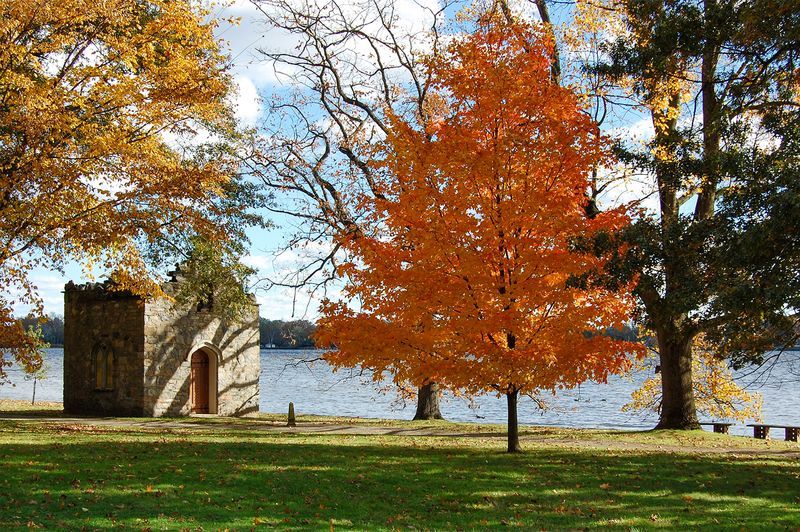
The foliage of Acer saccharum ‘Commemoration’ along the River Walk has really caught my eye in the full spectrum of fall hues. This contrasts the white oak (Quercus alba), which shifts swiftly from green to crimson red. Directly across the path, the green ash (Fraxinus americana) glows golden between the blue of the Delaware River and a cloudless sky. All three are native to our regional forests, and appreciating each specimen here in the Arboretum serves as a reminder of the importance of conservation, especially as we continue to lose so many ash trees to the emerald ash borer.
As for the team, we’ve been preparing for colder weather, building the bases of hoop houses to overwinter some of our more frost-sensitive species. We’ve also been enjoying a bit of experimental staking on greenhouse specimens, like the Clerodendrum thomsoniae.
And lastly, a very special treat in the Gold Garden… the Japanese persimmon (Diospyros kaki ‘Fuyu’) is ripening beautifully! Autumn is quickly becoming my favorite season (she says, until spring comes back around).
See you next week for a bittersweet farewell as this year’s Fellow’s Journal comes to a close.
October 31, 2025
I can’t believe how quickly time has flown. I’m sad to share that this will be my final post, as my season at Andalusia has come to a close. I’m filled with nothing but gratitude: to Kristin Biddle for her trust in me and for taking this fellowship from an idea to reality; to Head Gardener Bill Fuchs for his leadership and for sharing his historied knowledge of the garden with me; to the entire Horticulture team who bring so much joy into the work we do each day; and to the volunteers, whose care and dedication make this place thrive. I’m really going to miss this little garden family. It’s been such a joy to make so many wonderful, lifelong friends.
Andalusia has shaped me in more ways than I can count. I’ve grown so much this season, both as a gardener and as a garden professional. Every task, from refining fine-gardening techniques and experimenting with design to hedging and propagation, has offered lessons in observation and care. Each day has been an opportunity to learn and grow surrounded by the beauty of Andalusia, a garden as rich in history as it is in inspiration.
And finally, thank you to you, the friends and followers of Andalusia, for allowing me to share my journey with you. It has been a joy to write from the garden each week, and I can’t wait to follow along with you next season as the 2026 Fellow takes up the spade.