

June 23, 2026
John Biddle: A Brother in Exile
Written by Andalusia Research Assistant Brie Stoltzfus

Credit: Leah Grandy
The Biddle family responded immediately to support the Revolutionary cause, with brothers, siblings, cousins, and spouses working alongside each other in various contexts to support the war: brothers Edward, James, Charles, and Nicholas, along with their first cousins Clement and Owen, made crucial contributions to the Revolution through their work in the Continental Navy, Continental Army, Committee of Safety, or Continental Congress. Female members of the Biddle family, including Mary and Rebekah, found ways to champion independence within the scope of the period’s accepted gender roles.
However, John Biddle’s story stands apart as a fascinating contrast to the experiences of his siblings and cousins, as the only Loyalist in a large family of Revolutionary supporters. And unlike other family members of this era, the details of John’s life during the Revolution have remained largely in the dark; but in the process of researching his story, a trove of letters, newspaper articles, probate records, military pay records, and other primary sources have yielded new insights into John and his family’s unique experience of the Revolution.
John was born in 1736, the second oldest surviving son of William III and Mary Scull Biddle, and brother to James, Lydia, Edward, Charles, and Nicholas. During the French and Indian War, he served as a Deputy Quartermaster for the British Army under General Forbes and was present at the Battle of Fort Duquesne in 1758. (1) Subsequently, John followed in the footsteps of his grandfather Nicholas Scull II, as the only sibling in his immediate family to pursue the profession of surveying, at one point serving as a Proprietary Surveyor of Pennsylvania. (2) On February, 18 1769, an Act was passed to survey the boundary line between Lancaster, Berks, and Cumberland County and it is very likely that John Biddle, as Proprietary Surveyor, was part of this surveying project; he was later credited in his cousin William Scull’s “Map of Improved Parts of Pennsylvania” for his work on this project. (3) On October 19th, 1773, John married Sophia Weidner Boone, at St. Gabriel’s Episcopal Church in Douglassville, Berks County, Pennsylvania.

Record of John and Sophia’s wedding at St. Gabriel’s (Historical Society of Pennsylvania; Philadelphia, Pennsylvania; Historic Pennsylvania Church and Town Records; Reel: 582, Pennsylvania and New Jersey, Church and Town Records, 1669-1999)
In 1775, John served as a Collector of Excise in Berks County. (4) At the beginning of the Revolutionary War, he enlisted in a patriot militia, as Commissary of Colonel William Thompson’s Battalion of Riflemen, but at some point leading up to or during the tumultuous period of the British occupation of Philadelphia in 1777, John made the decision to commit to his loyalists leanings and joined a British militia as a Lieutenant in the Provincial Regiment of Infantry (West Jersey Volunteers) under John Vandyke in March 1778. (5)
By 1778, with his estate forfeited and his name published in newspapers as a traitor, John and his family fled to the Loyalist outpost of New York City. During this time, John appeared in the Guides & Pioneers Regiment muster roll under the rank of Lieutenant.
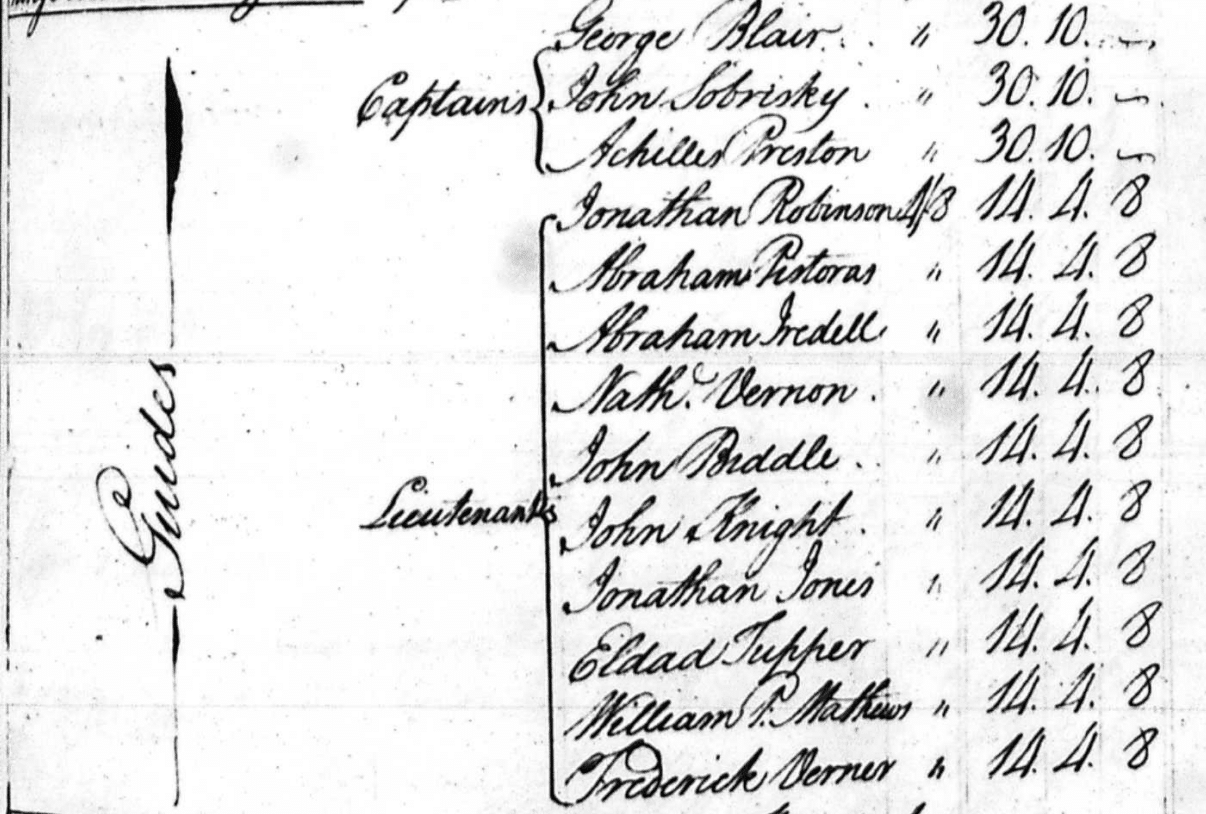
“Seconded Officers of Provincial Forces, 25 June to 24 August 1783 Inclusive” (Guy Carleton, British Headquarters Papers : 1747-1783, The Loyalist Collection, UNB Libraries, Document 8679, The National Archives (UK)
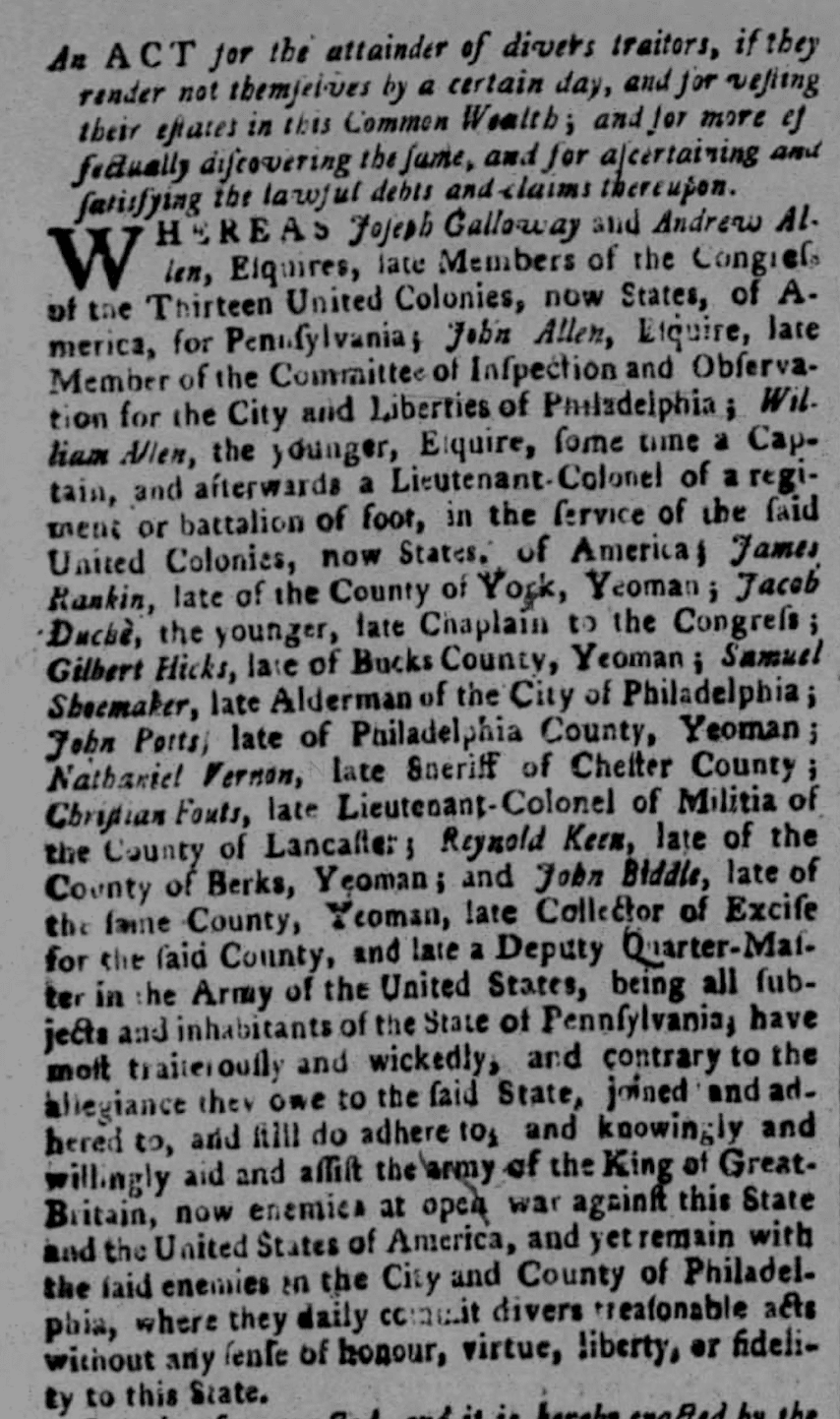
“An Act for the Attainder of divers traitors…,” Poulson’s American Daily Advertiser, April 22nd, 1778
Members of the Guides and Pioneers regiments in some cases included men who did not see action, but rather provided other means of support to the British army, as spies, engineers, surveyors and draftsmen. John’s background as a surveyor of Pennsylvania certainly would have lent itself to providing thorough details of roads and terrain for the use of the army. As a lieutenant in the Guides and Pioneers regiment, he was most likely receiving compensation during this period for this kind of service to the British army. (6)
A memorial letter written by Biddle’s fellow lieutenants in the Guides and Pioneers Regiment provides some confirmation of the nature of John’s assistance to the British. His fellow lieutenants requested continued support as the war came to a close in 1783, citing their usefulness earlier in the war:
“As Guides to the Royal Army On every Occasion whilst In the Province of Pennsylvania, where the many Exertions by Our knowledge of the Country were Attended with Success beyond the expectations of the Gentlemen who had the Honour to Command the different detachments to which we Acted as Guides…”
For their services as guides with “knowledge of the Country,” Sir William Howe, according to the lieutenants’ memorial letter, promised a lieutenant’s commission for life, and John and his fellow Lieutenants were most likely listed in the Guides & Pioneers Regiment in order to remain eligible to receive this compensation. (7)
Still, John was evidently concerned about his future after the war’s conclusion; his deep concern for his family’s welfare and lack of income led to his request for a position as a surveyor in Nova Scotia, most likely certain that he would never be able to return to Pennsylvania. He wrote to Sir Guy Carleton in 1780,
“That your memorialist for services rendered to his Majesty’s forces when in Pennsylvania rendered himself so obnoxious to the rulers of that Province that his person was attainted and his estate confiscated…your memorialist anxious to support a wife and family left destitute is desirous of going to Nova Scotia as a Surveyor.” (8)
An undated letter from his mother Mary Biddle to her sister suggests he may have been granted his wish for a position as a surveyor: “I have a Letter from my poor Jacky-—-he is gone to Halifax. The Commander-in-Chief has given him a Letter to the Governor to make him Deputy Surveyor, and allow him his Pay what he used to have, so my poor child will not be quite destitute.” (9)
Guy Carleton, a veteran military officer and colonial administrator, had been given the task of managing refugees under British protection and was asked to extend the “tenderest and most honorable care” to the Loyalists–whose number totaled upwards of 100,00 between soldiers and civilians–in helping them relocate. There were 35,000 Loyalists in New York City alone. As a member of a group of tens of thousands of other Loyalists seeking refuge in Nova Scotia and New Brunswick, John and his family took part in what remains the largest civilian transfer in American history. (10) The Guides and Pioneers regiment set sail for New Brunswick on the ship Ann on September 27th, 1783; it is possible John and his family were numbered in its two hundred and four passengers, although this cannot be verified without a surviving ship’s log. But based on thousands of other Loyalist refugees’ timelines, it is possible to conjecture that the Biddles would have arrived in their new country between the spring of 1783 and winter of 1784. (11)
Provincial Archives of New Brunswick Land Grants Index shows that the Biddles received a number of land grants. The earliest land grant to John Biddle was drafted in April 1785 for 150 acres in Sunbury County along the St. Croix River. John had earlier requested 100 acres along the Sissibou River in Digby County in a April 1784 memorial letter; however, no record of a formal grant was found for land on the Sissibou River, which suggests that John and his family did not receive a grant for that specific location, and instead accepted one in Sunbury County. The nature of their life and work while in New Brunswick is not clear, although it is obvious they were busy raising their large family; though historical records are sparse related to the birth dates and places of birth of their children, it is possible one or more of them were born after their emigration. (12)
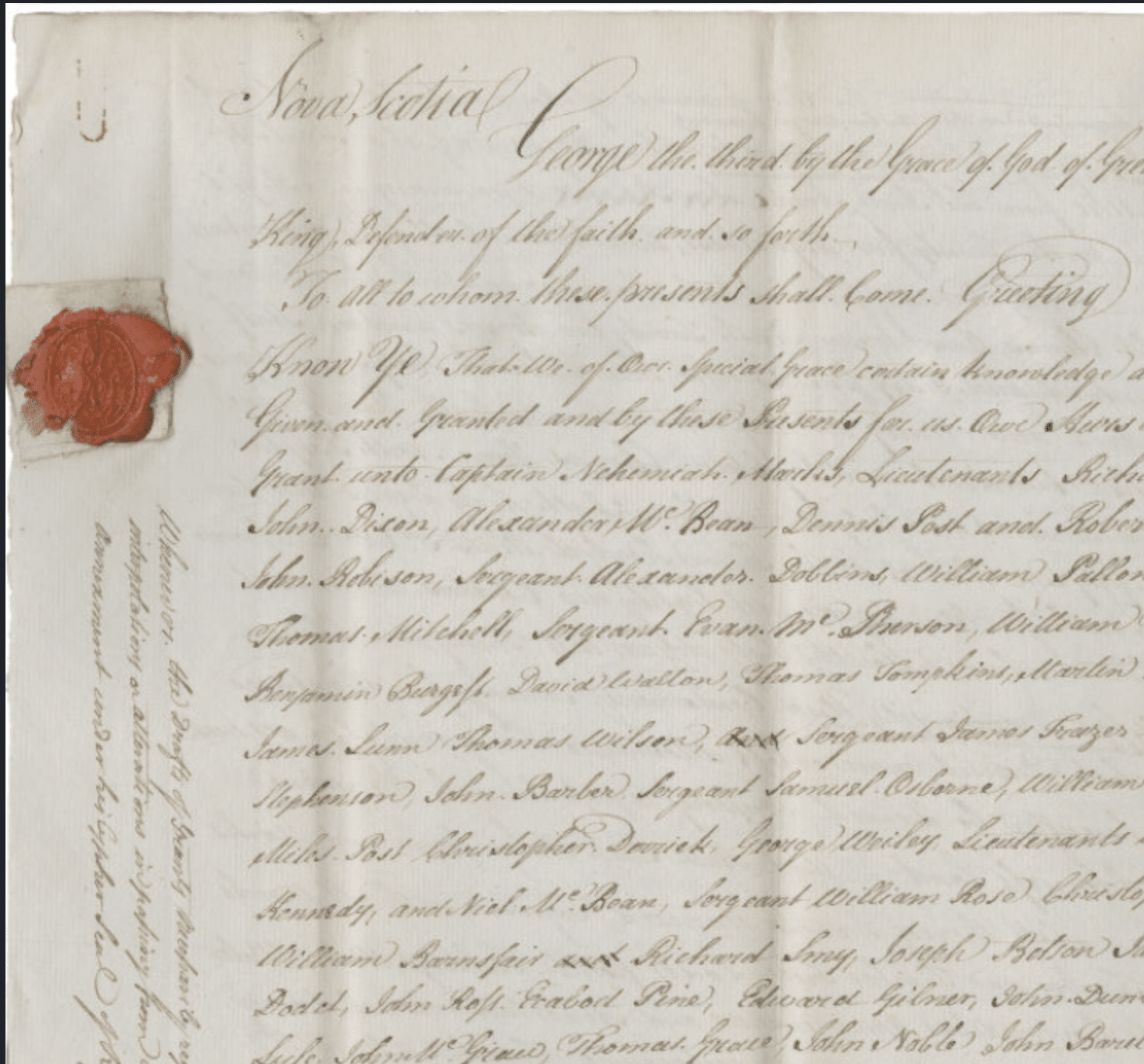
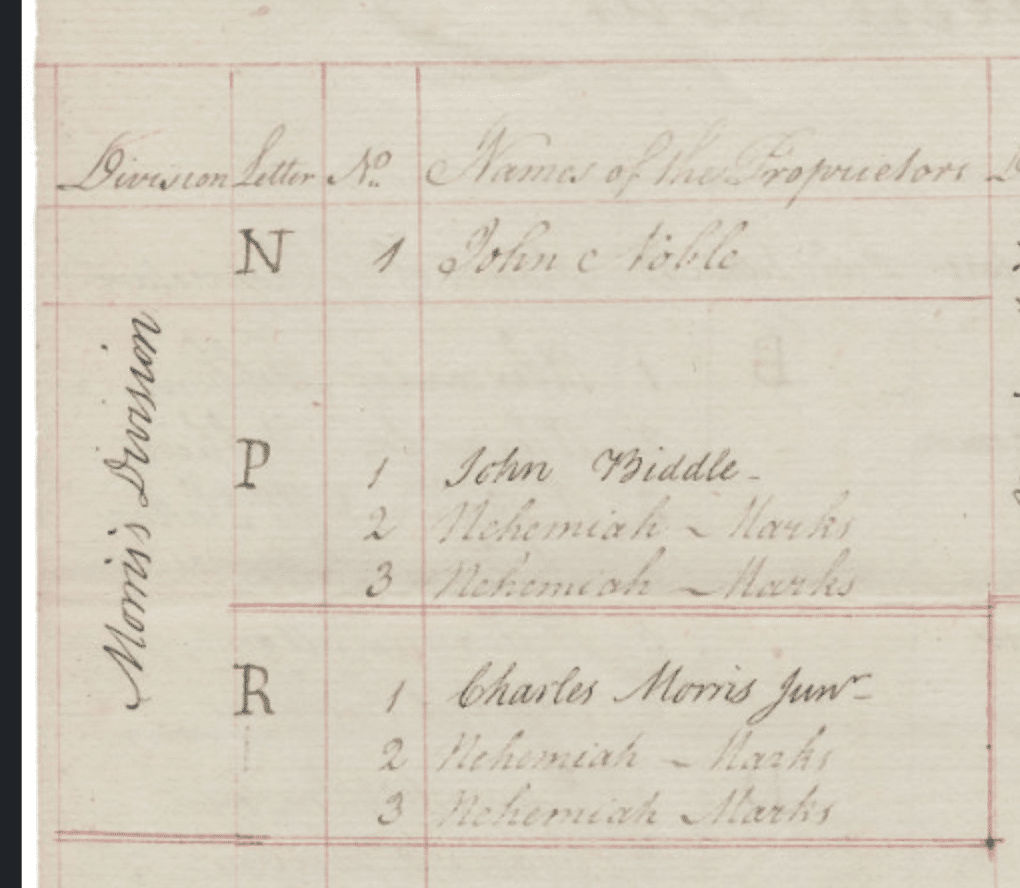
An excerpt of a draft grant from George III for 150 acres along the St. Croix River, above, and a list of proprietors of land grants, below. (Nova Scotia Archives)
It was extremely common for families to apply for new land grants, either because they were dissatisfied with the land they received originally or they desired additional land for the benefit of their descendents, and it appears that the Biddles applied for additional land grants in a different county a couple years after arriving to their new country. Three other land grants to John Biddle, one in 1788 for two hundred acres in Queensbury, York County, one in 1789 for 4 acres in Kingsclear, York County, and one in 1799 for 540 acres to the “heirs of the late John Biddle” in Kingsclear, demonstrate that the Biddles ultimately settled along the St. John River in Kingsclear. A probate record identifying John Biddle and his widow Sophia, indicating that John died in 1799 in Kingsclear, York County, New Brunswick, and a twentieth century cadastral map (caption), corroborate the Biddle family’s whereabouts at the time of John’s death. (13)
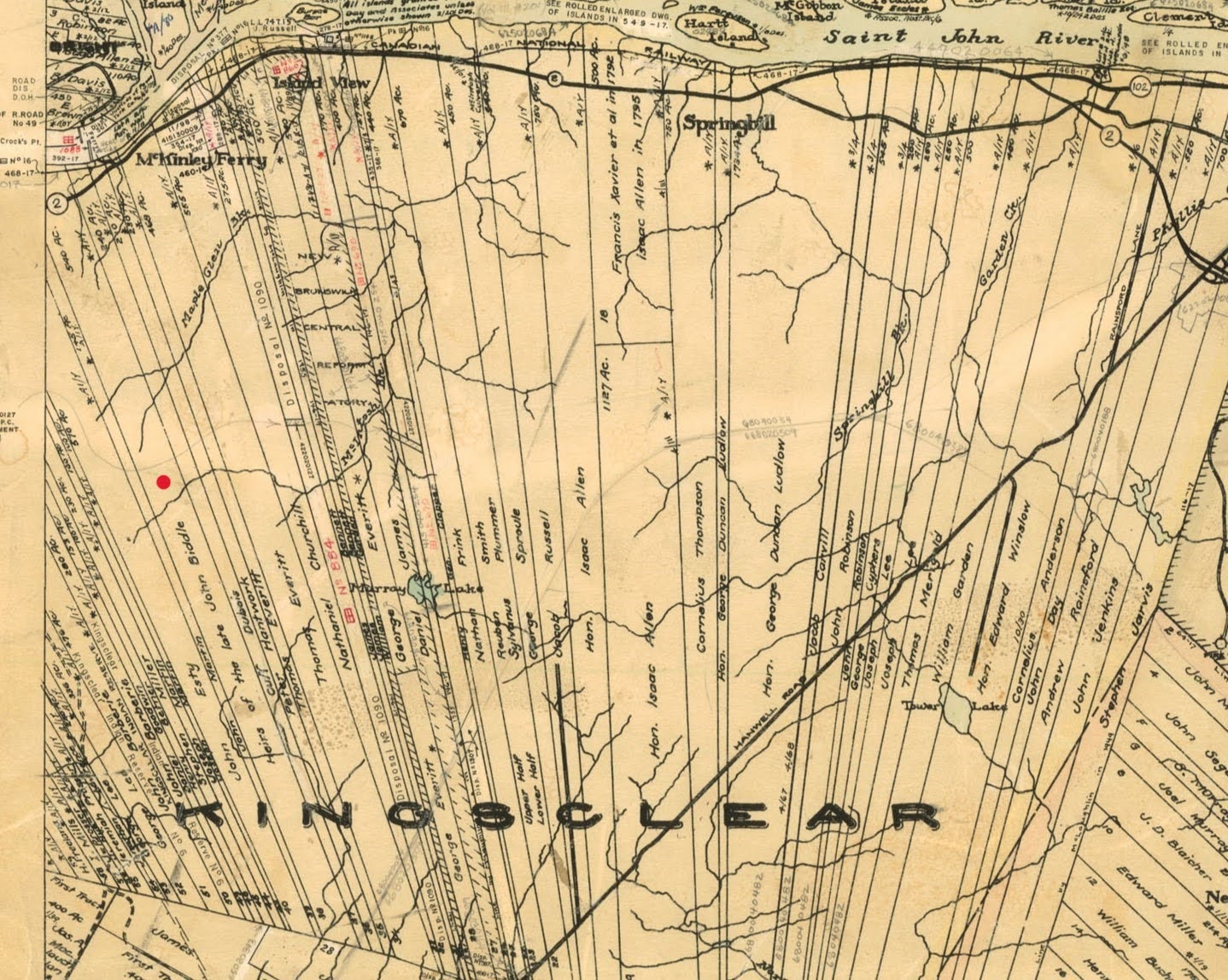
Cadastral maps, like this one of Kinsclear, show the boundaries, lot number, and the name of the owner of the land granted by the province. These cumulative data maps indicate all grants, regardless of the date of the grant. The red dot shows where “the heirs of the late John Biddle” received a grant in 1799. (Provincial Archives of New Brunswick)
A contemporary image of land located adjacent to the Biddles’ property on the cadastral map above, which provides a view of the St. John River that the Biddles would have enjoyed. (Credit: Leah Grandy)
Though they evidently held extensive property in New Brunswick, the Biddles did not remain there long. After John’s death, Sophia eventually returned to the United States, settling in Greensburgh, thirty miles south of Pittsburgh, and dying in Springfield, Clark County, Ohio, in 1837. Though Sophia and her children returned to their country of origin, John and Sophia’s chapter abroad set into motion their line’s “western diaspora” to Pittsburgh, Ohio, and Michigan, beyond the Biddle family’s historical ties to New Jersey, Philadelphia, and Reading. One of their sons, Edward Biddle, ultimately settled in Mackinac Island, Michigan around 1820, as a successful fur trader. The remainder of John’s previously forfeited Pennsylvania estate was ultimately restored to his family by the Pennsylvania General Assembly in 1803: “That all right, title, interest, property, claim and demand whatsoever, which this commonwealth, hath in, to and out of, such parts of the estate, real and personal of the said John Biddle, forfeited by his attainder aforesaid, as have not heretofore been seized, sold, aliened or any way disposed of, by and on account of the public, be, and the same are hereby granted, conveyed, assigned, set over, and vested in the said Sophia Biddle, for the use of herself and her children…as if the said John Biddle had never been attainted…” It is not clear whether or not one of John’s influential siblings or cousins had any part in this act of the General Assembly–and whether or not this public restitution by Pennsylvania brought any sense of closure for Sophia and her family. (14)
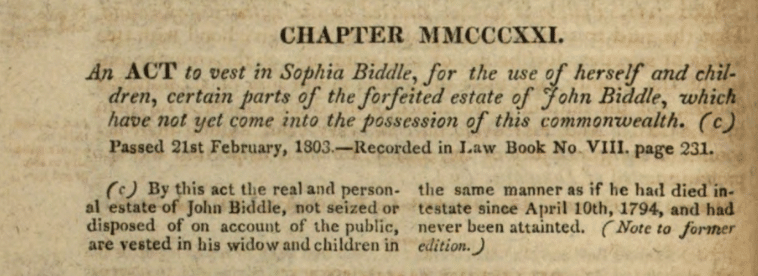
“Laws of the Commonwealth of Pennsylvania,” 1810
The choice to join the Revolutionary cause or to remain Loyal to the crown was a deeply personal one, and the various factors involved with John’s decision to remain loyal to Britain is unknown. A 1779 editorial reveals that political rivals of Edward Biddle used John’s loyalism to call his brother Edward’s patriotism into question. Edward’s own feelings–and the feelings of much of John’s family about his position– are lost to time. (15)
The only family member to comment publicly on John’s story is the family historian, Charles, who perhaps with the benefit of time had the ability to articulate his perspective on “my unfortunate brother John,” as he called him, in his autobiography. Charles expressed an unexpectedly sympathetic position for not only John–but Loyalists in general: “I felt much pain for these unhappy people,” Charles wrote, “I never felt the least angry with any of these people for their attachment to Great Britain; on political subjects every man has a right to enjoy his own opinion, and provided he does no mischief, should not be disturbed.” (16)
Charles’s sentiments may be surprising, but his openminded position makes perfect sense in light of another comment made at the very beginning of his autobiography: “I believe there never existed a family fonder of each other than we were.” The family loyalty that led to extensive Revolutionary collaboration amongst siblings and cousins, could also be unshakeable enough to extend an olive branch of understanding when one brother took a different position.
A special thank you to Leah Grandy, PhD, Archives & Special Collections Assistant (Microforms Collection) at University of New Brunswick Libraries for her generosity in helping me navigate the extensive resources of UNB’s archives and the Loyalist Collection–and for her invaluable assistance in interpreting these sources over the course of two years of correspondence.
Endnotes:
1. Biddle anniversary : celebrating the 250th anniversary of the arrival in America of William and Sarah Kempe Biddle ; held at the Pennsylvania Historical Society, Philadelphia, November 12th, 1931 / compiled by Nicholas Biddle., pg. 105, Internet Archive, https://dn790009.ca.archive.org/0/items/biddleanniversar00bidd/biddleanniversar00bidd.pdf
2. “West Jersey Volunteers Letter from John Biddle to Henry Clinton, September 21st, 1780,” The Online Institute for Advanced Loyalist Studies, https://www.royalprovincial.com/military/rhist/wjv/wjvmem3.htm
3. “Augusta Township, Berks County, February 18, 1769 — March 21, 1772,” John H. Carter, Sr., Berks County History Center.
https://berkshistory.org/article/augusta-township-berks-county/
4. Biddle Anniversary, pg. 105.
5. “West Jersey Volunteers Letter from John Biddle to Henry Clinton, September 21st, 1780,” The Online Institute for Advanced Loyalist Studies, https://www.royalprovincial.com/military/rhist/wjv/wjvmem3.htm
6. “A History of the Guides and Pioneers,” The Online Institute for Advanced Loyalist Studies, https://www.royalprovincial.com/military/rhist/g&p/gphist.htm
7. “Guides & Pioneers Memorial of Vernon, Iredell, Pastorius, and Knight,” The Online Institute for Advanced Loyalist Studies, https://www.royalprovincial.com/military/rhist/g&p/gpmem1.htm
8. “West Jersey Volunteers Letter from John Biddle to Henry Clinton”
9. “Notes on the Genealogy of the Biddle Family Together with Abstracts of Some Early Deeds,” by Henry. D. Biddle, 1895, pg. 94. https://www.ellerfamilyassociation.com/books/Biddle_Family.pdf
10. “Liberty’s Exiles: American Loyalists in the Revolutionary World,” Maya Jasanoff, 2011, Internet Archive. https://archive.org/details/libertysexilesam0000jasa_q6q7/page/n9/mode/2up
11. “Loyalist Ships,” United Empire of Loyalists Association of Canada, https://uelac.ca/loyalist-ships/
12. Provincial Archives of New Brunswick, Land Grants Collection, https://archives.gnb.ca/en-ca/land-grants/query/?p2=biddle&p3=true&p8=1784&p9=2007
13. Provincial Archives of New Brunswick, Wallace Hale’s Early New Brunswick Probate, 1785-1835, https://archives2.gnb.ca/Search/MC3706/Details.aspx?culture=en-CA&abstract=7419§ion=NameIndex
14. “Laws of the commonwealth of Pennsylvania /republished under the authority of the legislature, with notes and references,” ed. By John Bioren, 1810, pg. 540.
15. “To the Printer of the Pennsylvania Packet, Feb 11, 1779,” Poulson’s American Daily Advertiser, Philadelphia, Pennsylvania.
16. “Autobiography of Charles Biddle, Vice President of the Supreme Executive Council of Pennsylvania,” by Charles Biddle, 1883, pg. 143.